Symmetric Guitar Tunings
This article is an overview of what I call symmetric guitar tunings. I used the word "symmetric" because they actually have symmetries in a mathematical sense, and these symmetries result in useful musical properties.
Terminology and Notations
Before we begin, we need to define some terms and introduce some alternative guitar tuning notations to make things easier. The music theorist William Sethares has done similar work on guitar tunings, but my terminology and definitions will be different from his.
The number of strings in a tuning is called the string count.
A smaller consecutive part of a tuning is called a subtuning. For example, a 7 string tuning has two 6 string subtunings. The tuning that a subtuning belongs to is called the main tuning.
In a guitar tuning, the interval relationship between strings is the main factor that determines what chords and scales look like on the fretboard. For two different tunings that have the same interval relationships (like E standard and D standard), it'll be helpful to consider them the same relative tuning. We always use the lowest string as the reference point of a relative tuning.
There are 3 methods of representing a relative tuning. They use numbers instead of traditional note and interval names.
Method 1 is just using the intervals from the lowest string to each string. We use the number of semitones to represent the intervals. For example, we can represent the E standard tuning E A D G B E as 0 5 10 15 19 24. This is called Interval Notation (IN).
Method 2 is using the intervals between adjacent strings. I call these delta intervals. A delta interval is always the interval from the lower string to the higher string. For example, in E A D G B E, the delta interval is 5 between E and A, and 4 between G and B.
The E standard tuning can be represented as 0 5 5 5 4 5 using delta intervals. Just start from the lowest string, list the delta interval from the previous string to this string for each string. The lowest string is always 0, since it doesn't have a previous string. This is called Delta Interval Notation (DIN).
Method 3 is using pitch classes. The pitch class of the lowest string is 0 since it's the reference point. The E standard tuning can be represented as 0 5 10 3 7 0 this way. This is called Pitch Class Notation (PCN).
This article is about the general properties of symmetric tunings, so I'll use relative tunings mostly, but I may also give concrete examples of them that are practical for a normal guitar, with the appropriate string gauges. The gauges are calculated using the Stringjoy String Tension Calculator (25.5 scale length, electric guitar, nickel wound strings).
I also made an interactive fretboard chart maker (desktop only for now) that can display custom scales on custom tunings, and you can use it to understand the tunings listed here better.
Regular Tunings
A regular tuning is a tuning in which every delta interval is the same interval. In this case, this interval is called the generator interval. If a 6 string regular tuning has a generator interval of n, then its IN will be 0 n 2n 3n 4n 5n, and its DIN will be 0 n n n n n; PCN is more complicated since we need to do the calculations in modulo 12.
Here are some of the practical regular tunings:
Major Thirds Tuning
IN:        0     4     8     12    16    20
DIN:       0     4     4     4     4     4
PCN:       0     4     8     0     4     8
Example:   C2    E2    G#2   C3    E3    G#3
Gauges:    56w   46w   36w   28w   20    16
Tensions:  17.4  18.3  18.1  18.4  17.8  18.1
Major thirds tuning is defined by the generator interval 4 (major third).
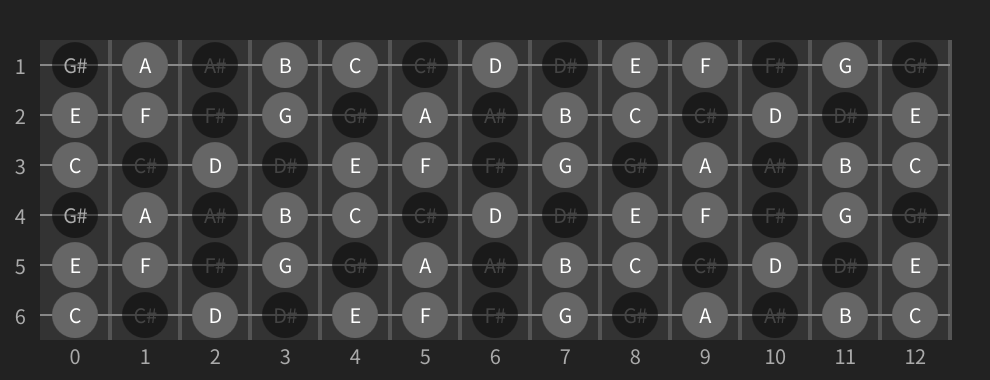
Because of the augmented 5th in here, it's not very easy to use the open strings for natural modes:
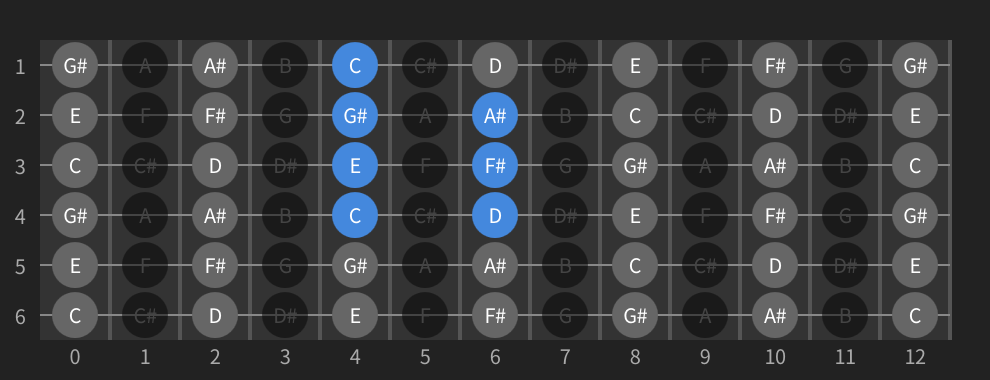
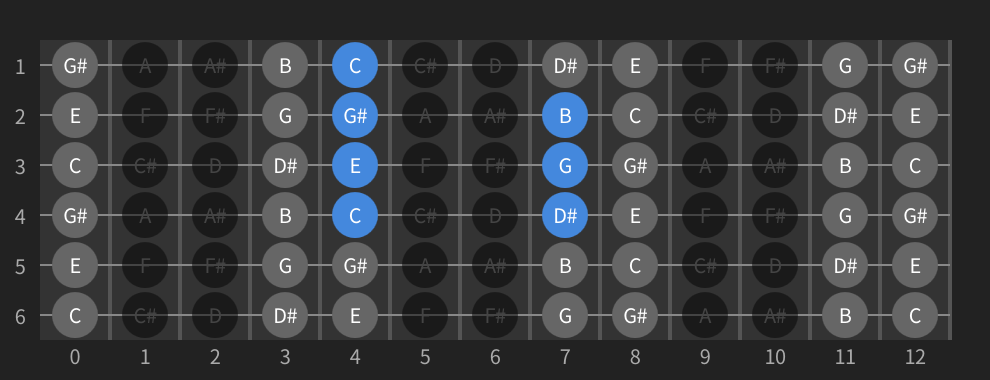
But this tuning is very good for the whole tone scale and the augmented scale:
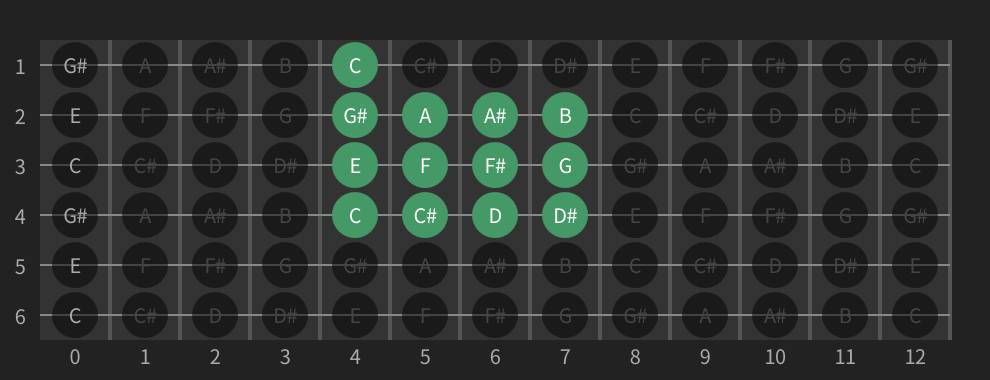
It also has the interesting property that you can play the whole chromatic scale using 4 fingers per string at the same position, but this doesn't have a real world use case:
All-fourths Tuning
IN:        0     5     10    15    20    25
DIN:       0     5     5     5     5     5
PCN:       0     5     10    3     8     1
Example:   E2    A2    D3    G3    C4    F4
Gauges:    48w   36w   26w   17    13    9.5
Tensions:  20    20.3  20    18.2  19    18.1
All-fourths tuning is defined by the generator interval 5 (perfect fourth). It's the most commonly used regular tuning; many famous guitarists have used it, like Tom Quayle, Alex Hutchings and Stanley Jordan.
Its advantage is that it fixes the annoying delta interval 4 in standard tuning (G to B) and makes regular fretboard shapes consistent everywhere. For example, in standard tuning, we need to learn 3 shapes for a root position major chord:
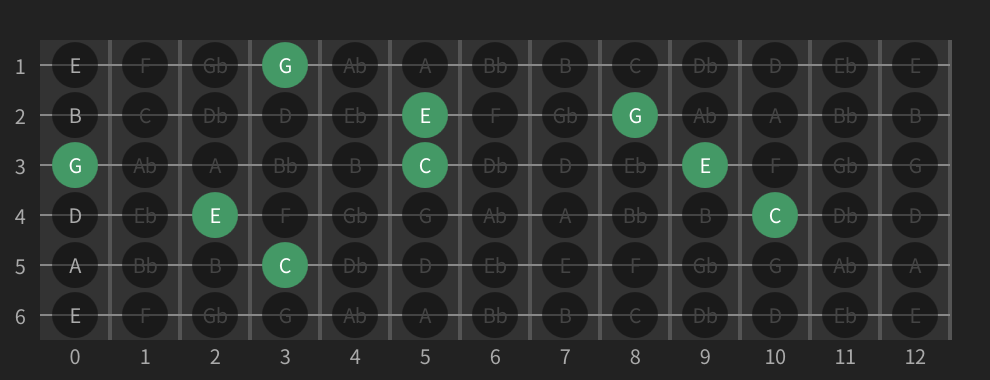
But we only need to learn one in all-fourths tuning:
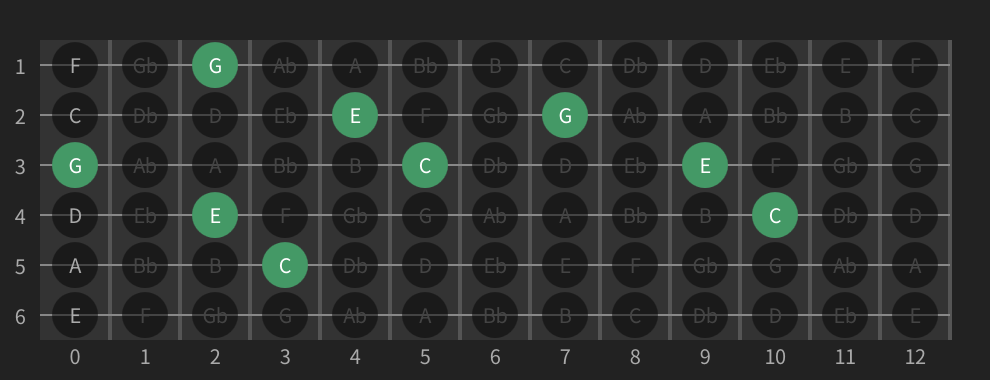
This is the major scale in standard tuning:
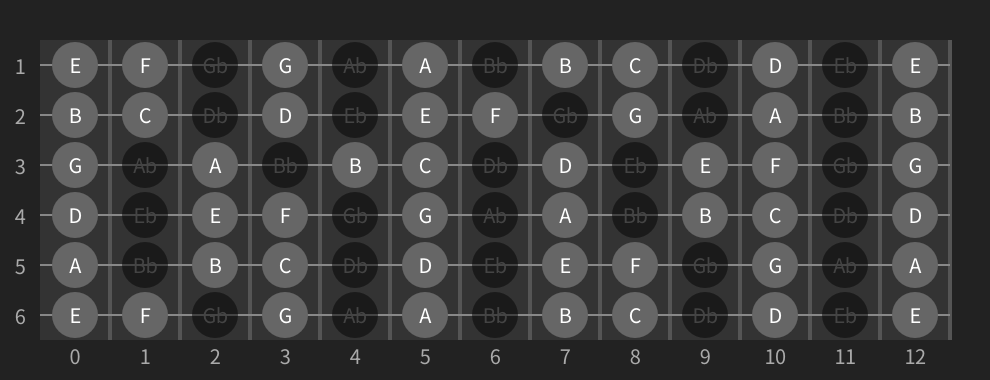
This is in all-fourths tuning:
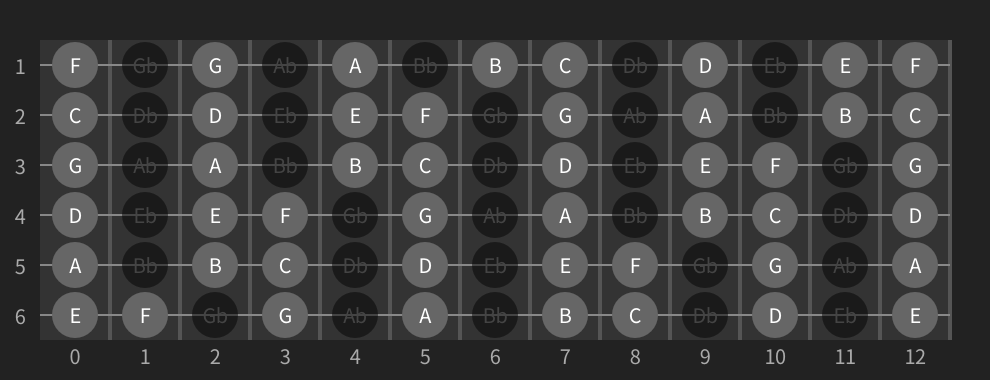
As you can see, it's much cleaner.
Tritone Tuning
IN:        0     6     12    18    24    30
DIN:       0     6     6     6     6     6
PCN:       0     6     0     6     0     6
Example:   B1    F2    B2    F3    B3    F4
Gauges:    62w   44w   30w   22w   13.5  9.5
Tensions:  19.1  19.1  18.6  19.7  18.2  18.1
Tritone tuning is defined by the generator interval 6 (tritone). Shawn Lane and Ron Jarzombek have used this tuning.
This tuning is pretty cool because it works really well with the 2 most common symmetric scales: the whole tone scale and the diminished scale. They are really easy to play in this tuning:
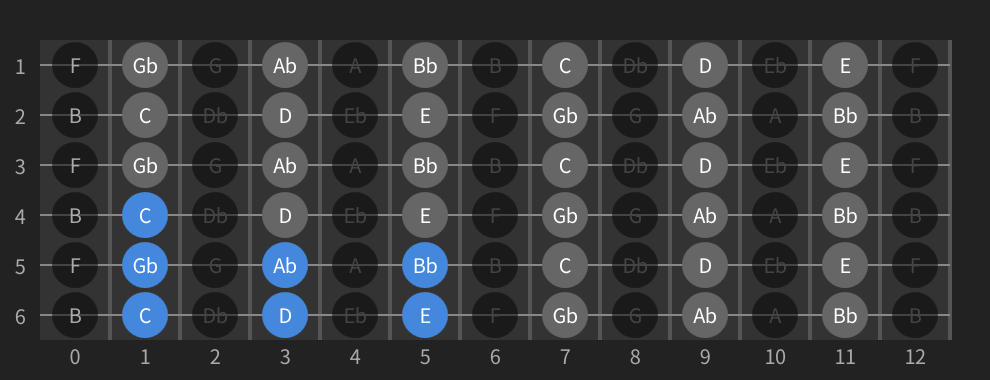
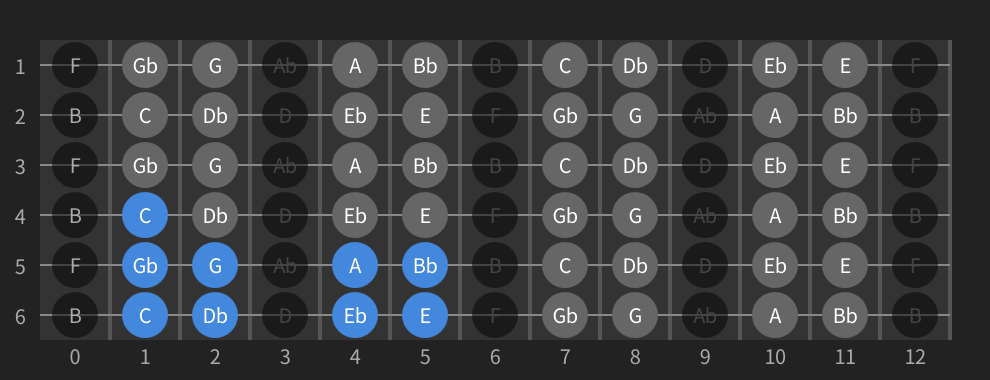
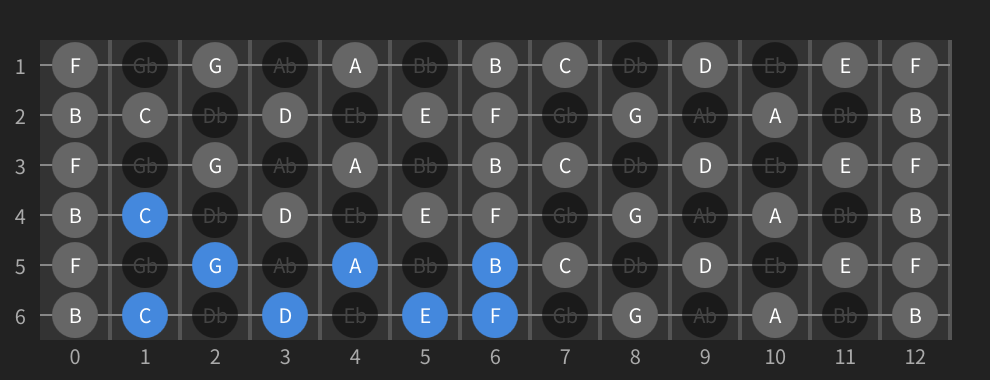
Also, look at how satisfying the shape of the major scale becomes (a bit awkward to play though):
All-fifths Tuning
IN:        0     7     14    21    28    35
DIN:       0     7     7     7     7     7
PCN:       0     7     2     9     4     11
Example:   F1    C2    G2    D3    A3    E4
Gauges:    80w   60w   40w   26w   15    10
Tensions:  14.9  19.8  19.9  20    17.9  17.8
All-fifths tuning is defined by the generator interval 7 (perfect fifth). Most instruments in the violin family are tuned this way. Allan Holdsworth used this tuning on his SynthAxe. Robert Fripp did something similar called the new standard tuning (C G D A E G), with the first string being G instead of B, because B was too high.
Modern guitarists tend to tune lower, and fan-fret guitars are common now, so our F C G D A E tuning is more reasonable.
In this tuning, we usually use 4 fingers to play a scale:
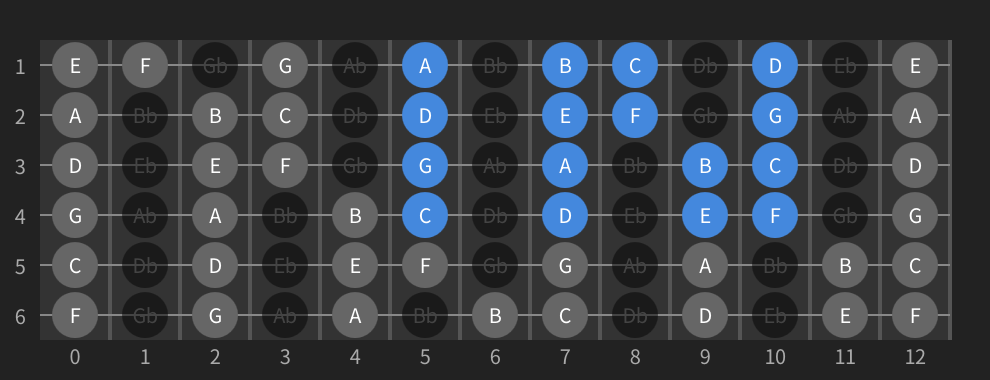
It's not very easy to play because the stretches are pretty big, especially at the lower positions.
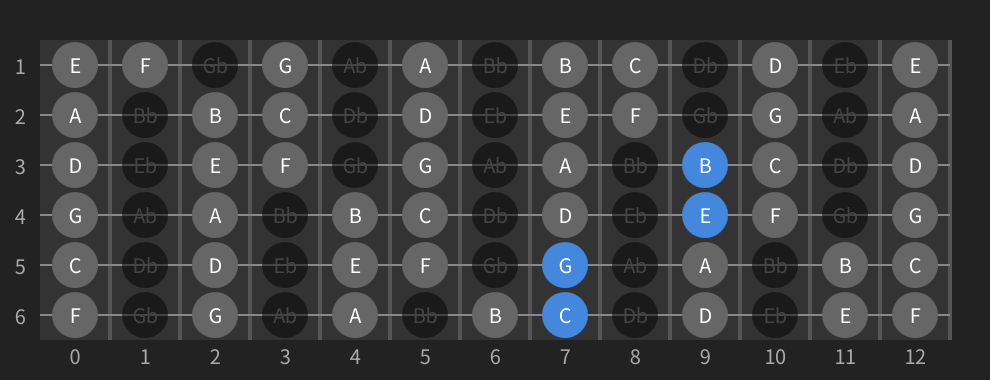
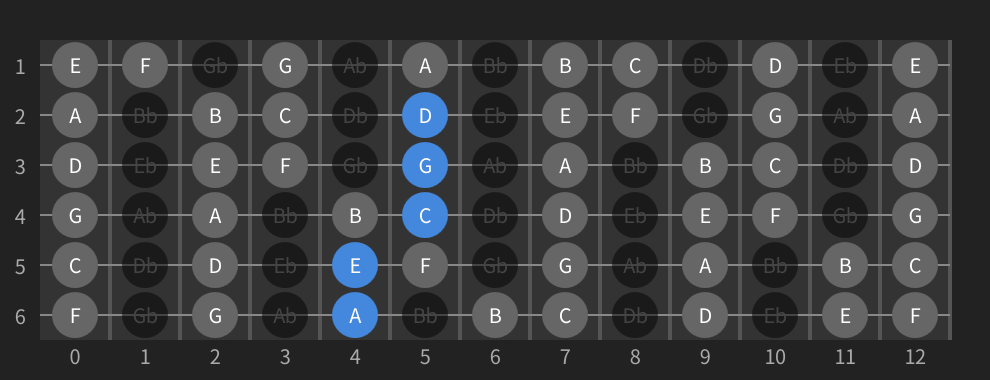
This tuning makes some quintal harmony chords much easier to play:
Repetitive Tunings
A repetitive tuning is a tuning that is constructed by concatenating a subtuning and its successively higher octave transpositions. This subtuning is called the tuning pattern, and its string count is the pattern length.
An occurrence of the tuning pattern or its octave transpositions is called a repetition. A repetitive tuning must have at least 2 complete repetitions, and the last repetition can be incomplete if you already have 2 complete ones.
Since we need to have at least 2 full repetitions, the pattern length must be less than or equal to half of the string count of the tuning. So for 6 string tunings, we know there can only be 3 pattern lengths: 1, 2 and 3.
If the pattern length is 1, the tuning pattern must be 0, so we only have one main tuning. It's not practical because the range will be too large (5 octaves), and we don't have strings for that:
IN:        0     12    24    36    48    60
DIN:       0     12    12    12    12    12
PCN:       0     0     0     0     0     0
Example:   E1    E2    E3    E4    E5    E6
Gauges:    85w   48w   24w   10    --    --
Tensions:  15.3  20    21    17.8  --    --
If the pattern length is 2, with the tuning pattern 0 n, the main tuning will be:
IN:        0     n     12    12+n  24    24+n
PCN:       0     n     0     n     0     n
If the pattern length is 3, with the tuning pattern 0 m n, the main tuning will be:
IN:        0     m     n     12    12+m  12+n
PCN:       0     m     n     0     m     n
So for a pattern length of 2 or 3, the range will be about 2 to 3 octaves, which is more doable.
There are only a few practical 2 pattern length repetitive tunings, and I'll list all of them.
On the other hand, there are many practical 3 pattern length repetitive tunings, because they are also open tunings: you can choose any 3 note chord and repeat it again. I'll only list 2 of them that have other useful properties besides being open tunings.
Fourth-fifth Tuning
Pattern length: 2

IN:        0     5     12    17    24    29
DIN:       0     5     7     5     7     5
PCN:       0     5     0     5     0     5
Example:   C2    F2    C3    F3    C4    F4
Gauges:    60w   46w   30w   19    13    9.5
Tensions:  19.8  20.6  20.8  18.1  19    18.1
Fourth-fifth tuning is defined by the tuning pattern 0 5. I use this name because to go to the next octave from the lowest string you first add a fourth (5) then add a fifth (7).
This tuning is not that commonly used; the folk guitarist Nick Drake has used it (B E B E B E) in some of his songs, and that's the only famous person that I can find from a simple search. I personally used C F C F C F exclusively for a while and I really like it.
Its advantage is that it shares the same 2 string shapes with the standard tuning because of the delta interval 5 in the tuning pattern 0 5. You get to use familiar 2 string scale shapes while also being able to move them by octaves at the same position. This makes playing scales really simple:
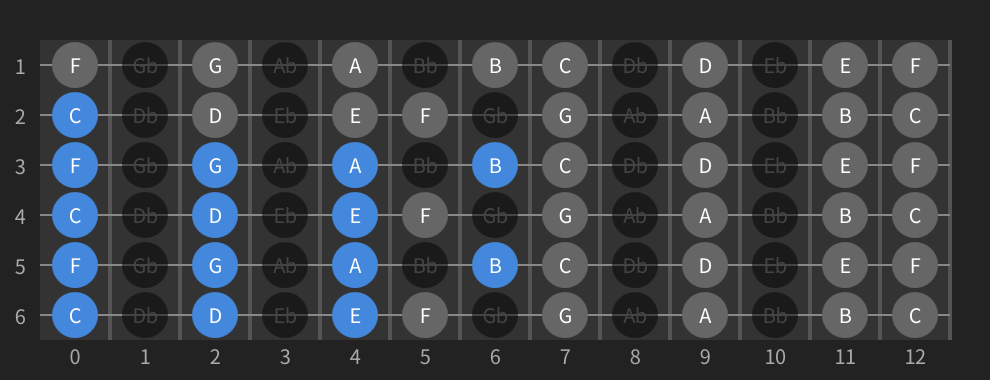
However, the shapes will be different if you start at an odd string, because the delta interval in the 2 string shape is now 7:
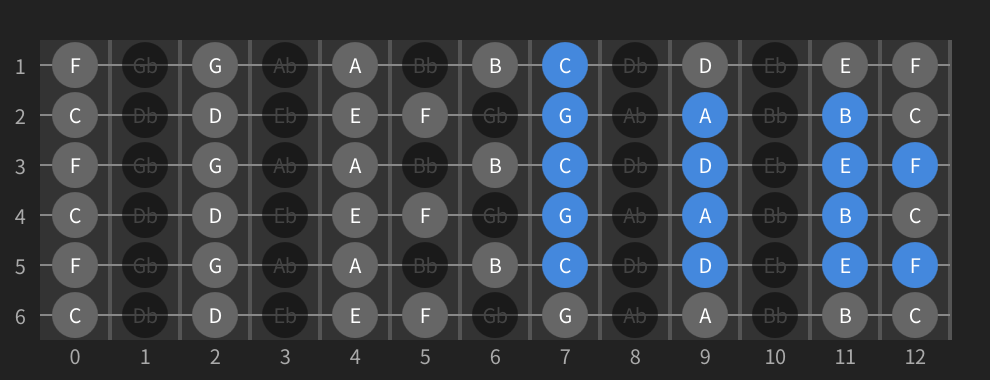
From my experience, I tend to not use the odd strings as starting points because of this, which is maybe not a good thing.
Tritone Tuning
Pattern length: 2

IN:        0     6     12    18    24    30
DIN:       0     6     6     6     6     6
PCN:       0     6     0     6     0     6
Example:   B1    F2    B2    F3    B3    F4
Gauges:    62w   44w   30w   22w   13.5  9.5
Tensions:  19.1  19.1  18.6  19.7  18.2  18.1
Tritone tuning is both a regular tuning and a repetitive tuning. I call tunings like this regular repetitive tunings, and tritong tuning is the only 2 pattern length regular repetitive tuning. It can be defined by the generator interval 6 or the tuning pattern 0 6.
I've already introduced it in the regular tuning section, so let's just talk about the differences between it and other 2 pattern length repetitive tunings. It fixes the "different shapes at the odd strings" problem that I mentioned above:
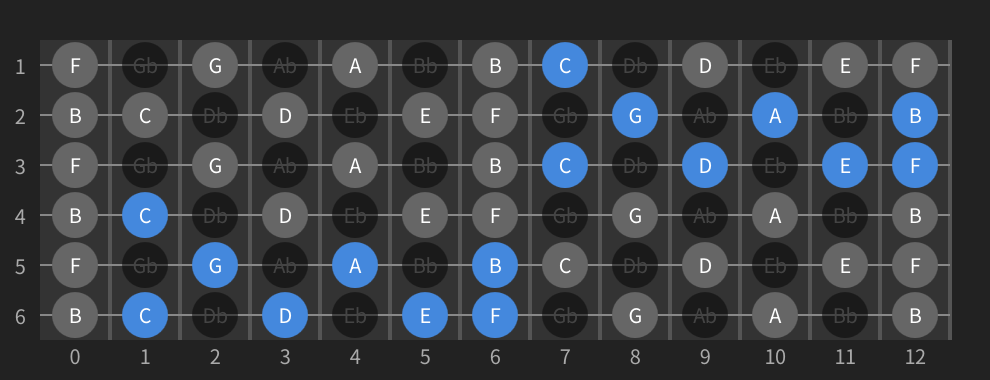
But the cost is that it's awkward for natural modes.
Fifth-fourth Tuning
Pattern length: 2

IN:        0     7     12    19    24    31
DIN:       0     7     5     7     5     7
PCN:       0     7     0     7     0     7
Example:   A1    E2    A2    E3    A3    E4
Gauges:    64w   46w   34w   22w   15    10
Tensions:  16.3  18.3  18.9  17.6  17.9  17.8
Fifth-fourth tuning is defined by the tuning pattern 0 7. I name this in the same way as the fourth-fifth tuning. The ruan is tuned in this way. David Maxim Micic has used Ab Eb Ab Eb Ab Bb and Devin Townsend has used C G C G C E; both are very close to this tuning.
This tuning is the ultimate drop tuning because the one finger 6 string bar chord is just a big power chord. It's very good for heavy music.
Here is the major scale on this tuning:
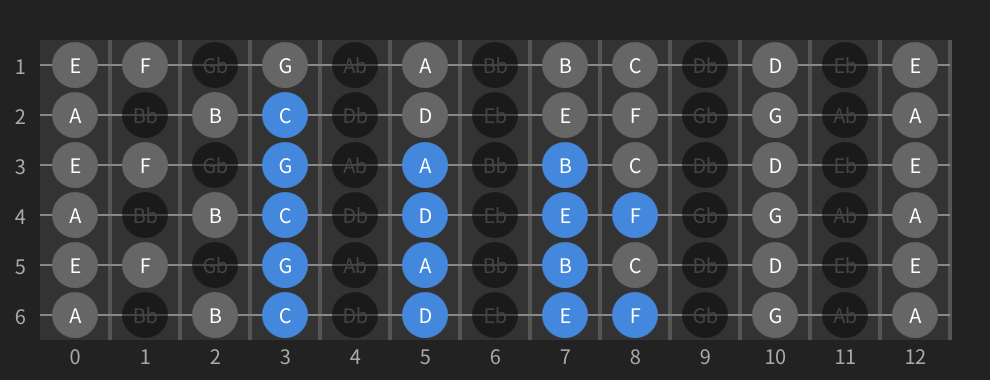
It's the same shape as the one you get when you start the scale at the odd strings in the fourth-fifth tuning. Fifth-fourth tuning makes you use this shape more.
Major Thirds Tuning
Pattern length: 3

IN:        0     4     8     12    16    20
DIN:       0     4     4     4     4     4
PCN:       0     4     8     0     4     8
Example:   C2    E2    G#2   C3    E3    G#3
Gauges:    56w   46w   36w   28w   20    16
Tensions:  17.4  18.3  18.1  18.4  17.8  18.1
Major thirds tuning is the only 3 pattern length regular repetitive tuning. It can be defined by the generator interval 4 or the tuning pattern 0 4 8.
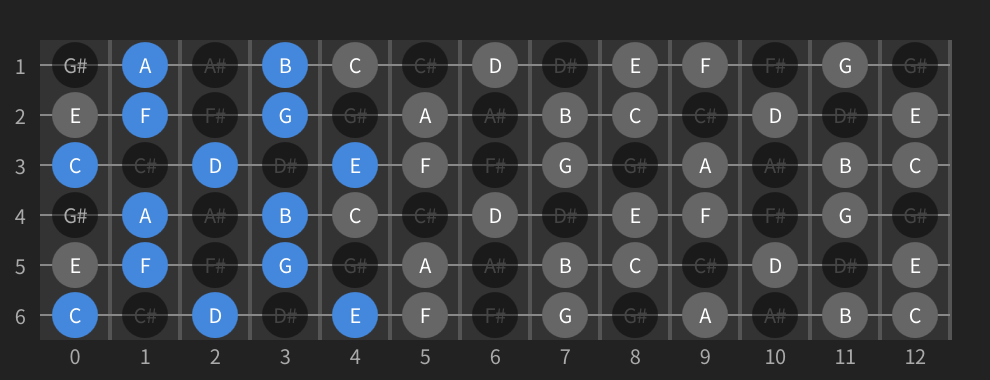
To play a scale in this tuning, we usually use 2 fingers per string. We already saw this when I introduced it in the regular tuning chapter:
And this is how you play the major scale in it, also using 2 fingers per string (mostly):
Quartal Triad Tuning
Pattern length: 3

IN:        0     5     10    12    17    22
DIN:       0     5     5     2     5     5
PCN:       0     5     10    0     5     10
Example:   E2    A2    D3    E3    A3    D4
Gauges:    48w   36w   26w   20    15    11
Tensions:  20    20.3  20    17.8  17.9  17.1
Quartal triad tuning is defined by the tuning pattern 0 5 10. The tuning pattern itself is a regular tuning, and its generator interval is 5. I used this name for the tuning because 0 5 10 is a quartal harmony triad, and also because it hints at the 3 pattern length and the generator interval 5 (fourth).
TesseracT and Monuments use 7 string tunings that have this as a subtuning. For example, TesseracT uses A E A D E A D.
As in fourth-fifth tuning, you can use familiar standard tuning shapes while being able to move them up an octave at the same position. For this reason, it's very good for arpeggios:
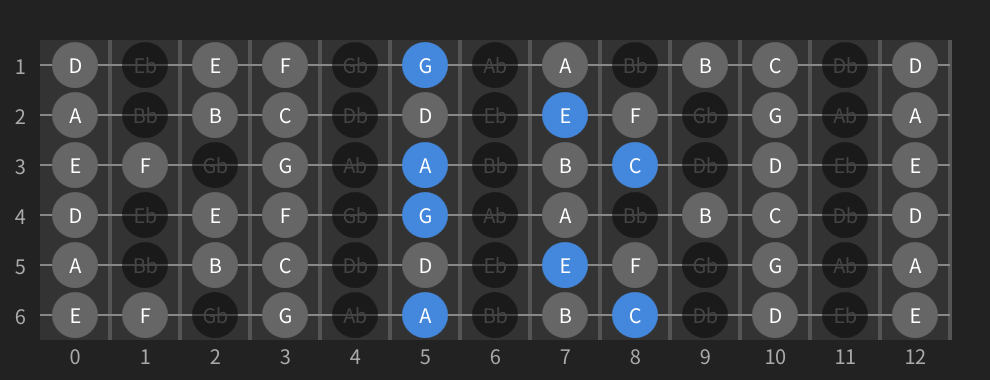
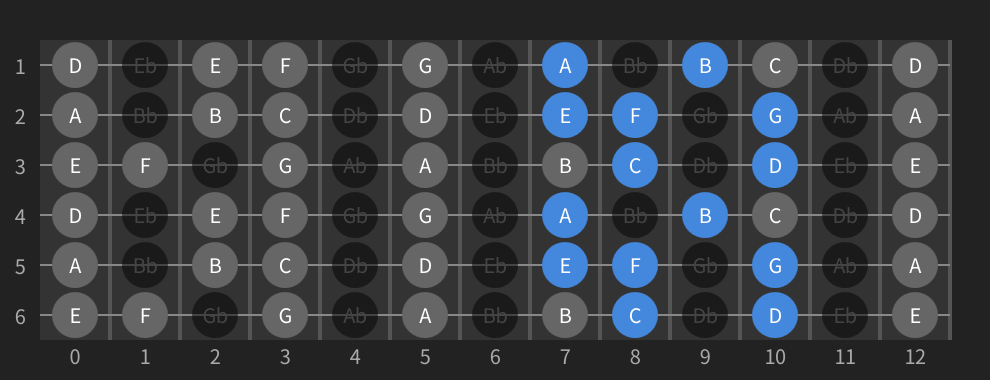
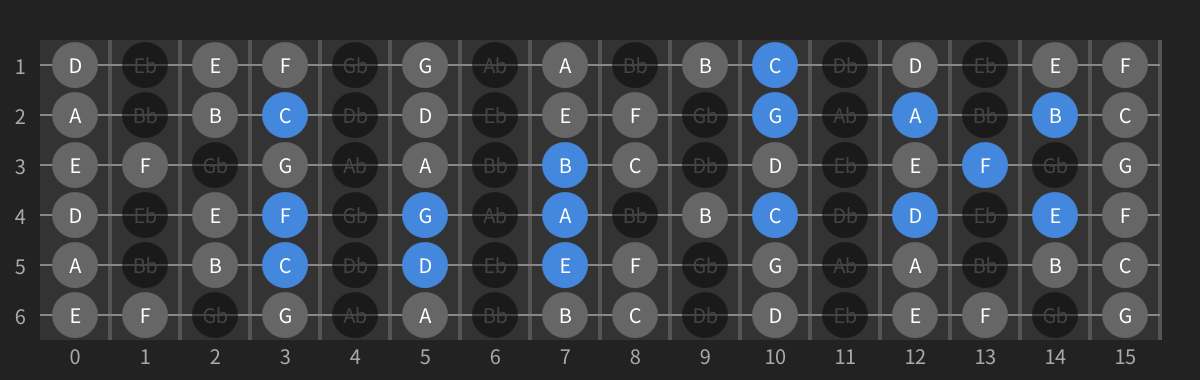
But playing scales is kinda weird. If you just want to play the major scale sequentially, the default fingering of the standard tuning may not work the best, because you will only use 1 finger on the last string of the tuning pattern:
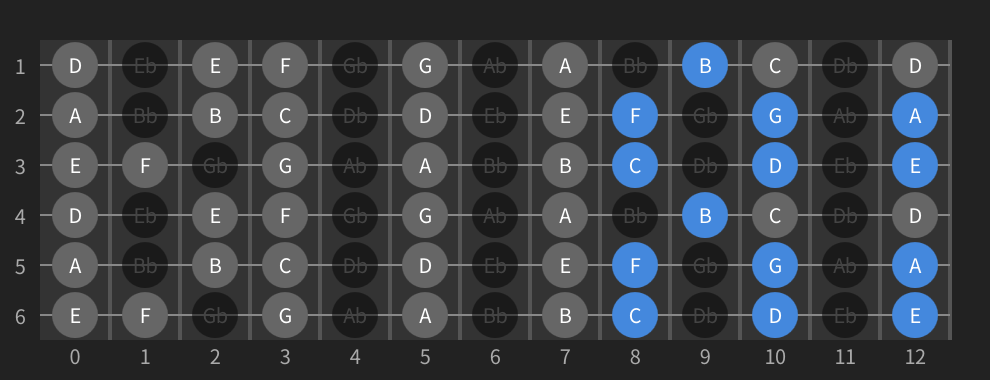
You may want to change to this:
And you probably don't want to start the scale at the 5th or the 4th string:
Other Tunings
There are some other types of tuning that can be considered symmetric, but they are not that useful. I'll still list them here.
Interval Pattern Tunings
An interval pattern tuning is a tuning that is constructed by stacking an interval pattern for at least 2 times. An interval pattern is just a sequence of delta intervals.
For example, if we have the interval pattern 4 5, by stacking it, we can get the DIN of the tuning, and then we can calculate other notations:
DIN:       0     4     5     4     5     4
IN:        0     4     9     13    18    22
PCN:       0     4     9     1     6     10
Technically speaking, regular tuning is just a special case of interval pattern tuning (with pattern length 1), and so is repetitive tuning (try interval pattern 5 7). But, except for these two special cases, I feel like interval pattern tunings have very limited uses.
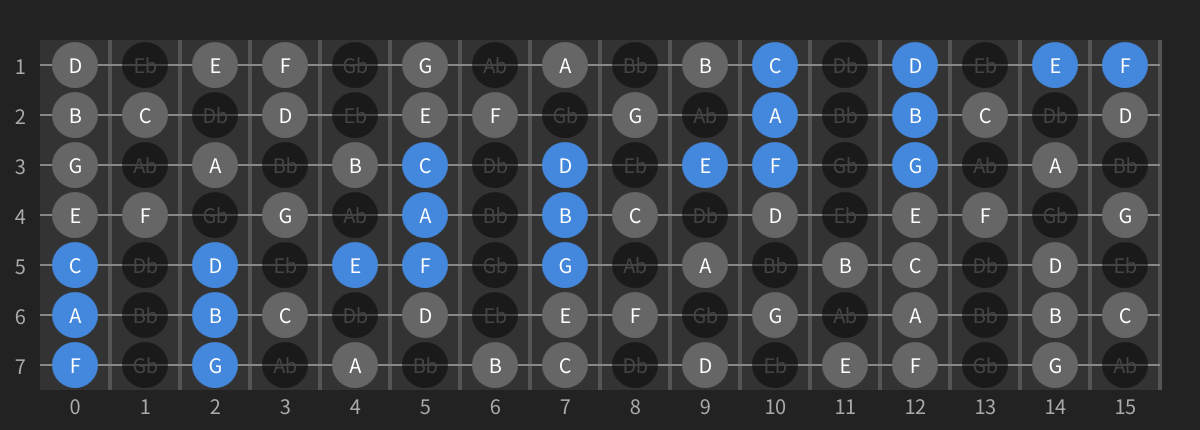
I do want to list one interval pattern tuning that is maybe useful. This is the tertian harmony tuning, a 7 string tuning defined by the interval pattern 4 3:
IN:        0     4     7     11    14    18    21
DIN:       0     4     3     4     3     4     3
PCN:       0     4     7     11    2     6     9
Example:   F2    A2    C3    E3    G3    B3    D4
Gauges:    46w   36w   30w   24w   17    13.5  11.5
Tensions:  20.6  20.3  20.8  21    18.2  18.2  18.7
This is the lydian mode on tertian harmony tuning. You can see that it does have symmetric shapes:
Reflective Tunings
A reflective tuning is a tuning that's constructed by stacking an interval pattern and its retrograde inversion.
For example, if we have the interval pattern 4 5, its retrograde inversion will be 7 8:
4 5 -> (12 - 5) (12 - 4) -> 7 8
Stack them together, and we get this tuning:
DIN:       0     4     5     7     8
IN:        0     4     9     16    24
PCN:       0     4     9     4     0
As you can see from the PCN, the tuning has a reflecting axis on the 3rd string (9).
Jacob Collier uses the reflective tuning D A E A D on his 5 string guitars. Here is this tuning in relative tuning form:
IN:        0     7     14    19    24
DIN:       0     7     7     5     5
PCN:       0     7     2     7     0
Example:   D2    A2    D3    A3    D4
This is what the major scale looks like on this tuning:
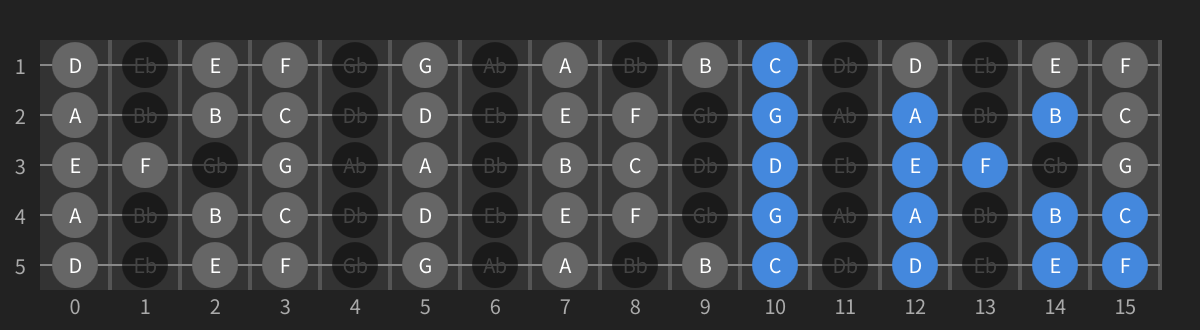
The whole fretboard does look symmetric, but as you can see, if you want to actually play the scale, the scale won't be symmetric, so I don't think this property actually helps you. Jacob seems to use this more as an open tuning.